
Menu
The Lorry Driver Who Almost Lost His Leg: Lessons Every Patient Should Learn from Persistent Leg Pain
Published on:
October 03, 2026
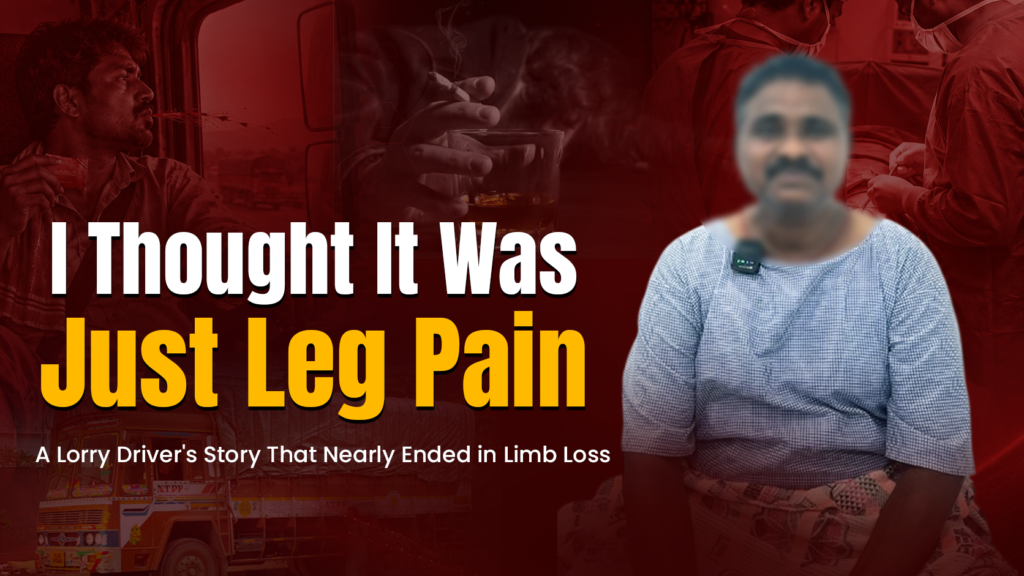
The Lorry Driver Who Almost Lost His Leg: A Lesson in Listening to Symptoms
By Dr. Sridhar Devu
Chief Interventional Radiologist
As doctors, we frequently meet patients who arrive with one sentence:
“Doctor, I thought it was just normal leg pain.”
Most of the time, that statement comes after months of discomfort, self-medication, and delayed medical attention.
Recently, I met a patient whose journey reminded me why awareness is often as important as treatment itself.
He was a lorry driver from Warangal.
Like thousands of professional drivers across India, he spent long hours on the road transporting goods between states. Driving was not merely his profession—it was the foundation of his family’s livelihood.
What began as occasional pain in his leg gradually became a life-altering problem.
The most concerning part?
He never imagined that the symptoms could eventually threaten his ability to walk.
When "Just Pain" Is Not Just Pain
Leg pain is one of the most commonly ignored symptoms in healthcare.
People often blame it on:
- Long working hours
- Aging
- Muscle strain
- Fatigue
- Driving or standing for long periods
In many cases, these explanations are correct.
However, vascular disease often starts with symptoms that appear deceptively ordinary.
This patient initially noticed:
- Leg pain
- Tingling sensations
- Pulling discomfort
- Progressive weakness
Like many people, he chose the easiest solution available.
Painkillers.
Temporary relief followed.
Then the symptoms returned.
This cycle continued for months.
Unfortunately, while the pain was being suppressed, the underlying vascular condition continued to progress.
The Hidden Danger of Delayed Diagnosis
One of the biggest challenges in vascular medicine is that blood vessel disease often develops silently.
The body adapts.
Patients learn to tolerate discomfort.
Walking distances become shorter.
Daily activities become slower.
The decline is gradual enough that many people fail to recognize how serious the condition has become.
By the time this patient underwent further evaluation, the disease had already reached an advanced stage.
Several healthcare professionals had warned him that further delay could lead to severe consequences.
For any patient, hearing such words is frightening.
For a man whose livelihood depended on mobility, the fear was even greater.
A Journey That Revealed the Severity of the Problem
The detail that stayed with me most was not found in a scan report.
It came from the patient himself.
During our discussion, he described travelling from Warangal to Hyderabad for treatment.
By that stage, walking had become extremely difficult.
He explained that even reaching the train compartment required assistance.
For someone who had spent years driving across the country independently, this represented a dramatic loss of confidence and freedom.
Medical reports reveal disease.
Patient stories reveal its true impact.
Looking Beyond the Scan
One of the most important principles in interventional radiology is understanding the person behind the diagnosis.
A successful treatment plan requires more than reviewing investigations.
It requires understanding:
- Occupation
- Daily physical demands
- Lifestyle habits
- Symptom progression
- Long-term goals
Every patient is different.
The treatment that works for one individual may not be the most appropriate option for another.
That is why personalized vascular care remains essential. Dr. Sridhar Devu specializes in minimally invasive vascular and endovascular procedures, with extensive experience in conditions such as peripheral vascular disease, DVT, varicose veins, and complex vascular interventions. (Dr. Sridhar Devu)
The Evolution of Modern Vascular Treatment
Years ago, many vascular conditions required major surgery and prolonged recovery periods.
Today, advances in endovascular medicine have transformed the treatment landscape.
Using image-guided technology, specialists can often restore blood flow through minimally invasive techniques that focus on precision, safety, and faster recovery. Endovascular and interventional radiology procedures are increasingly used to treat vascular diseases through targeted, image-guided approaches. (Dr. Sridhar Devu)
The greatest advantage is not simply the procedure itself.
It is the opportunity to preserve mobility, independence, and quality of life.
For many patients, that outcome matters more than anything else.
Three Warning Signs Patients Should Never Ignore
This case highlights three symptoms that deserve prompt medical evaluation:
1. Persistent Leg Pain
Pain that repeatedly returns despite medication should not be dismissed.
2. Numbness or Tingling
Changes in sensation may indicate compromised circulation or nerve involvement.
3. Reduced Walking Ability
If walking becomes increasingly difficult, the underlying cause should be investigated rather than tolerated.
Early diagnosis often creates more treatment options and better long-term outcomes.
Another Lesson: The Value of Health Insurance
The patient’s family had taken a step years earlier that proved invaluable during a medical emergency.
They had health insurance.
When serious illness occurs, families should focus on treatment decisions—not financial distress.
Although insurance cannot prevent disease, it can significantly reduce the burden associated with unexpected healthcare expenses.
What This Patient Taught Me
Every patient leaves behind a lesson.
This particular journey reinforced something I often tell people:
The body whispers before it starts shouting.
Persistent symptoms deserve attention.
Pain is information.
Numbness is information.
Difficulty walking is information.
Ignoring those signals does not make the problem disappear.
It only delays the opportunity to address it.
Final Thoughts
When I think about this case, I do not remember the scans first.
I remember a hardworking lorry driver who simply wanted to continue supporting his family.
I remember a patient who nearly accepted his symptoms as normal.
And I remember how different the outcome could have been had the condition remained untreated.
Awareness is not a substitute for treatment.
But awareness is often what brings patients to treatment before it is too late.
That is why stories like these matter.
Doctor's Quote
“Many patients ignore leg pain because they believe it is part of aging, work, or daily stress. However, persistent pain, numbness, or difficulty walking should never be ignored. Early diagnosis remains one of the most important factors in preserving mobility and preventing serious vascular complications.”
— Dr. Sridhar Devu
DMRD, DNB, MD, FRCR, PDCC, AMPH
Endovascular Interventional Radiologist
Frequently Asked Questions
If leg pain is persistent, recurrent, and associated with numbness, weakness, or difficulty walking, a vascular evaluation may be appropriate.
Yes. Reduced blood flow to the legs can contribute to pain, cramping, heaviness, and reduced walking capacity.
No. Leg pain can arise from muscles, joints, nerves, or blood vessels. Proper diagnosis is essential.
Endovascular treatment uses image-guided minimally invasive techniques to diagnose and manage vascular conditions. (Dr. Sridhar Devu)
Early diagnosis often allows intervention before complications become severe, helping preserve function and quality of life.