
Menu
When a Patient Told Me He Could Only Sleep by Listening to Old Songs: A Varicose Veins Journey That Stayed With Me
Published on:
September 30, 2026
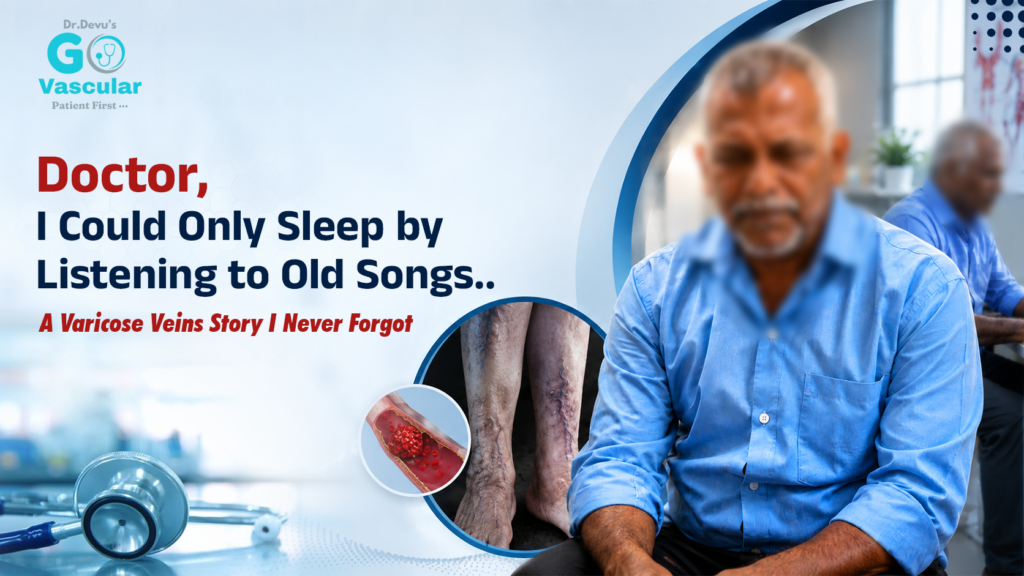
When a Patient Told Me He Could Only Sleep by Listening to Old Songs
A Doctor’s Reflection on a Varicose Veins Journey
By Dr. Sridhar Devu
Chief Interventional Radiologist
Some patient stories stay with you long after the treatment is over.
Not because they are medically complex.
But because they remind you how deeply a health condition can affect a person’s daily life.
A few months ago, I met a gentleman named Subrahmanyam from a village near Gudivada. During our consultation, he described his pain in a way I have never forgotten.
“Doctor, some nights I would listen to old songs just to distract myself from the pain in my legs.”
That single sentence told me more about his suffering than any scan or report could.
The Hidden Burden of Varicose Veins
Many people think varicose veins are simply enlarged veins that affect appearance.
In reality, some patients experience persistent pain, heaviness, swelling, skin changes, and even ulcers that interfere with their quality of life. Early evaluation is important because symptoms can gradually progress over time if left unaddressed. (Go Vascular)
When Subrahmanyam visited us, he had already been living with leg pain for a long time.
Like many patients, he initially ignored the symptoms.
He assumed it was fatigue.
He assumed it would improve on its own.
It didn’t.
Instead, the discomfort slowly became part of his daily life.
A YouTube Video Started the Conversation
One aspect of his story reflects how healthcare is changing today.
He first came across my educational videos online.
He later told me that what convinced him to seek consultation was not a promise of treatment but an explanation.
He appreciated hearing that varicose veins do not have a one-size-fits-all solution.
Different patients require different approaches depending on their symptoms, vein anatomy, disease stage, lifestyle, and treatment goals.
That is something I strongly believe in.
Medicine should never be about forcing a treatment.
It should be about helping patients understand their options.
Fear Was the Real Problem
When I examined him, I noticed that the physical condition was only one part of the challenge.
The larger issue was fear.
He had already developed a venous ulcer.
He was worried about what might happen next.
He had consulted another centre before meeting us and had been told surgery would be necessary.
As doctors, we sometimes underestimate the emotional impact of words like “operation” or “surgery.”
For many patients, those words create anxiety long before treatment begins.
That is why patient counselling is such an important part of healthcare.
Before discussing treatment, we discussed his concerns.
We discussed his expectations.
Most importantly, we discussed his fears.
Every Patient Deserves Individualized Care
One of the most common misconceptions about varicose veins is that every patient requires the same procedure.
That is simply not true.
Modern vascular care offers multiple treatment options, including minimally invasive endovascular techniques designed to reduce discomfort and recovery time. (Go Vascular)
For Subrahmanyam, we carefully reviewed the available options and discussed the advantages and limitations of each.
I encouraged him to discuss the decision with his family and take the time he needed.
In my experience, patients make better decisions when they feel informed rather than pressured.
The Importance of Trust
One lesson I have learned throughout my career is that successful treatment begins with trust.
Before any procedure starts, patients need confidence in what is being done and why it is being done.
Subrahmanyam returned after discussing the options with his family.
He felt comfortable moving forward.
At that point, the treatment itself became the easy part.
The difficult part—the uncertainty and anxiety—had already been addressed.
A Small Change That Meant Everything
What I remember most is not the procedure.
It is what happened afterward.
Later that day, he told us he could already feel a difference.
The heaviness was improving.
The discomfort was reducing.
More importantly, he seemed relieved.
Not simply because a treatment had been completed.
But because he finally felt hopeful.
As physicians, these are the moments we remember.
Not the scans.
Not the reports.
Not the procedures.
The moments when patients realize they may finally be moving forward.
Healthcare Is More Than Technology
Modern interventional radiology has transformed the way many vascular conditions are managed.
Advanced image-guided procedures allow specialists to treat many conditions through minimally invasive techniques rather than traditional open surgery. Dr. Sridhar Devu specializes in image-guided treatments for conditions including varicose veins, DVT, fibroids, varicocele, and peripheral vascular disease. (drdev)
But technology alone is never enough.
Patients remember conversations.
They remember reassurance.
They remember whether someone listened.
Subrahmanyam’s story is a reminder that healthcare is ultimately about people.
My Message to Patients
If there is one lesson from this story, it is this:
Do not ignore symptoms simply because they develop gradually.
Persistent leg pain, heaviness, swelling, visible veins, skin discoloration, or ulcers deserve medical attention.
Early evaluation can help patients understand the cause of their symptoms and explore appropriate treatment options before complications develop. (Go Vascular)
Final Thoughts
Years from now, I may not remember every clinical detail of this case.
But I will remember one sentence.
“Doctor, some nights I would listen to old songs just to distract myself from the pain.”
That sentence reminds me why patient education matters.
Why awareness matters.
And why every patient story deserves to be heard.
Doctor Quote
“The best treatment decisions happen when patients understand their condition, understand their options, and feel empowered to participate in their own care.”
— Dr. Sridhar Devu
MBBS, DMRD, DNB, MD, FRCR, AMPH, PDCC
Endovascular Interventional Radiologist (drdev)
Frequently Asked Questions
No. Some patients may experience pain, heaviness, swelling, skin changes, and ulcers if the condition progresses. (Go Vascular)
No. Treatment depends on the patient's symptoms, vein anatomy, and disease severity. Multiple minimally invasive options may be available. (Go Vascular)
Persistent leg pain, swelling, heaviness, visible veins, skin discoloration, or ulcers should be evaluated by a vascular specialist. (Go Vascular)
Glue ablation is a minimally invasive technique that uses a specialized medical adhesive to close diseased veins. (Go Vascular)
Early diagnosis can help prevent progression of symptoms and allow patients to explore treatment options before complications develop. (Go Vascular)