
Menu
When Six Years of Varicose Veins Becomes More Than Pain: What Krishna Swamy’s Story Teaches Us
Published on:
October 13, 2026
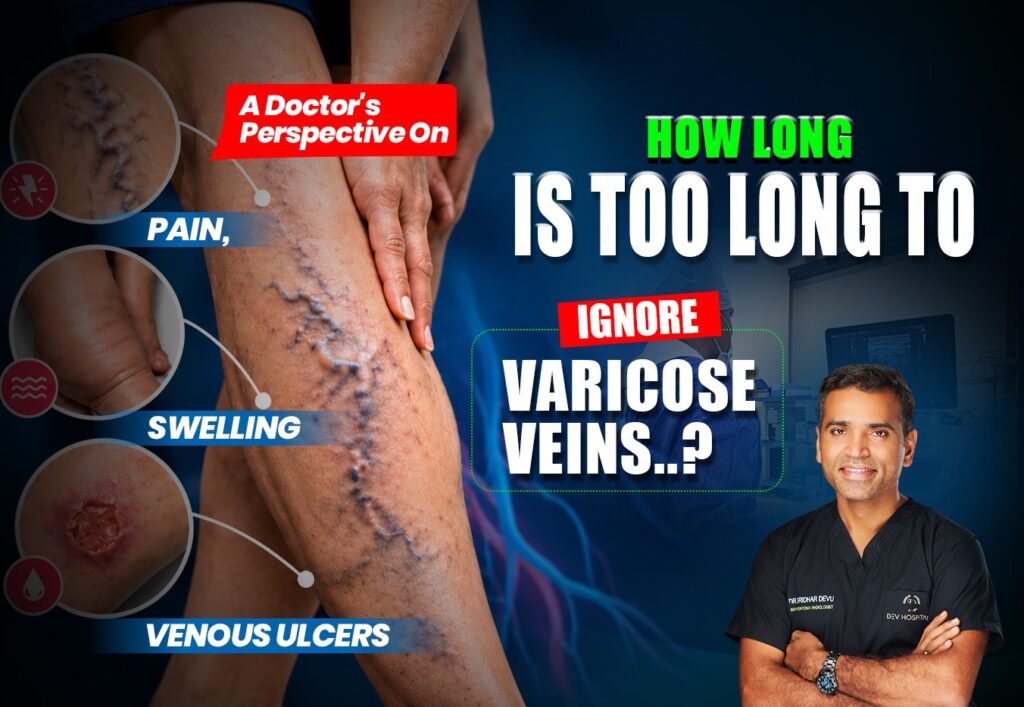
As a doctor, one of the things I notice repeatedly in patients with varicose veins is how long they wait before seeking a proper evaluation.
The visible veins are often not what brings them to the clinic.
It is usually the pain they can no longer tolerate.
The swelling that does not settle.
The heaviness that makes it difficult to continue working.
Or, sometimes, a wound or ulcer that finally tells them the problem should not be ignored any longer.
Krishna Swamy’s story is one such example.
At 54, he had been living with varicose veins for approximately six years. His work in a sweet shop required him to remain standing for long hours, roughly from morning until the afternoon.
For years, he tried to manage the problem.
He used medicines. He looked for advice online and on YouTube. He even tried Ayurvedic treatment, spending around ₹9,000 a month for three months.
But his symptoms continued.
Eventually, the problem became much harder to ignore.
When Standing All Day Becomes a Daily Struggle
Varicose veins are enlarged, twisted veins that commonly develop in the legs. For some people, they remain mainly a cosmetic concern. For others, they can cause aching, heaviness, itching, swelling, and skin changes.
Symptoms can become more noticeable after prolonged standing and may improve when the legs are elevated.
For someone whose livelihood depends on standing for several hours, this can become particularly difficult.
Krishna Swamy described significant evening swelling and pain. At times, he had to keep his legs elevated using pillows to obtain some relief.
That detail is important.
Patients often adapt their daily lives around chronic symptoms without realizing that the adaptation itself may be a sign that the disease is affecting their quality of life.
They stop walking as much.
They rest more frequently.
They elevate their legs.
They tolerate pain because they still have work to do.
And they tell themselves that tomorrow might be better.
From Swelling to Skin Problems: When the Story Changes
The most concerning part of Krishna Swamy’s experience was that his symptoms did not remain limited to pain and swelling.
He eventually developed skin problems and a small ulcer or wound, along with fluid discharge.
A venous leg ulcer is a break in the skin of the lower leg that does not heal within the expected period. Venous ulcers can occur alongside swelling, skin discoloration, hardened skin, and other chronic venous changes. They can also become infected, particularly when there is increasing pain, redness, fever, or unpleasant discharge.
This is why I would encourage patients not to treat a persistent wound on a leg with varicose veins as simply a skin problem.
The underlying venous circulation needs to be assessed.
NICE guidance recommends specialist assessment for clinically significant varicose veins and recommends duplex ultrasound to confirm the diagnosis and identify the extent and location of venous reflux when planning treatment.
A wound can be the visible part of a much larger circulation problem
The Problem With Treating Symptoms Without Understanding the Cause
One of the biggest challenges in varicose vein care is that patients may spend years trying different medicines, home remedies, stockings, or alternative treatments without understanding what is actually causing the abnormal veins.
That does not mean every earlier treatment was necessarily inappropriate.
It means the next step should be understanding the vascular problem itself.
Modern evaluation is not simply about looking at the veins from outside.
We need to understand how blood is flowing through them, where reflux is occurring, and whether there are other venous or arterial issues that could influence treatment.
This is where duplex ultrasound becomes an important part of assessment.
Once the anatomy and reflux pattern are understood, treatment can be discussed according to the individual patient’s condition.
Guidelines include endovenous approaches such as endothermal ablation and other minimally invasive options, with treatment selection based on suitability and clinical findings.
There is no single treatment that should automatically be offered to every patient.
Why Krishna Swamy Finally Decided to Act
Interestingly, Krishna Swamy did not initially rush to a hospital.
He had financial responsibilities.
He had work.
He had already spent money trying different approaches.
And like many patients with chronic conditions, he had learned to live with the discomfort.
He first came across information about vascular treatment through Dr. Sridhar Devu’s YouTube videos.
That changed something important—not necessarily the disease itself, but his understanding of the disease.
He began to see that persistent leg pain and swelling were not symptoms he simply had to tolerate forever.
He eventually came to Go Vascular for evaluation and treatment.
According to his account, his symptoms improved following treatment.
That is his individual experience, and every patient’s response can be different.
The Lesson I Take From His Story
For me, Krishna Swamy’s story is not simply about treating varicose veins.
It is about recognising when a chronic symptom has crossed the line from inconvenience to a problem that deserves proper medical attention.
A person who spends hours standing every day may dismiss leg heaviness as part of the job.
A person with swelling may think it is because of the weather or tiredness.
Someone with visible veins may think treatment is only necessary for appearance.
But persistent pain, swelling, skin changes or a non-healing wound deserve evaluation.
The goal is not to frighten patients.
The goal is to give them enough clarity to make an informed decision before the problem begins affecting more of their everyday life.
A Message to Patients Living With Varicose Veins
You do not have to make a treatment decision simply because someone tells you to.
But you also should not ignore symptoms simply because you have learned to live with them.
A proper vascular consultation can help answer the questions that matter:
What is causing the varicose veins?
Is there venous reflux?
How advanced is the condition?
Are the symptoms related to the veins?
What treatment options are appropriate for me?
What happens if I continue to delay evaluation?
These are much more useful questions than simply asking, “Which medicine should I take?”
Doctor's Perspective
“What concerns me most is not the number of years a patient has had varicose veins, but how much the condition has gradually changed their daily life. Persistent pain, swelling, skin changes or an ulcer should prompt proper vascular evaluation rather than continued self-treatment. The right treatment depends on the patient’s venous anatomy, symptoms and overall clinical assessment.”
— Dr. Sridhar Devu
Chief Interventional Radiologist
Frequently Asked Questions
Yes. Varicose veins may be associated with aching, heaviness, discomfort and swelling, particularly after prolonged standing.
Chronic venous disease can be associated with venous leg ulceration. A wound that does not heal normally should be medically assessed.
Duplex ultrasound is recommended in specialist assessment to confirm varicose veins, identify venous reflux and help plan treatment.
No. Treatment depends on symptoms, clinical findings, venous anatomy and individual circumstances. Different treatment options may be appropriate for different patients.
No. Venous leg ulcers often require specialist treatment, and signs such as increasing pain, discharge, redness or fever can indicate infection and warrant prompt medical attention.